A Hidden Fossil Tooth Reveals How a Giant Predatory Fish Attacked a Plesiosaur in Prehistoric Alabama (Discovermagazine)
Last edited Mon Mar 23, 2026, 06:01 AM - Edit history (3)
Written by Stephanie Edwards
Mar 16, 2026, 4:30 PM | 3 min read
***
A new study, published in the Journal of Vertebrate Paleontology, revealed an embedded tooth in one of ancient Alabama’s fiercest marine predators. By utilizing high-tech scanning, scientists uncovered this hidden surprise tucked inside a fossil that had been sitting in a museum drawer for decades. The new find is rewriting our understanding of the ancient food chain and proves that even the toughest ocean dwellers had very bad days.
***
CT Scans Reveal Tooth in Plesiosaur Fossil
The story begins at Chicago’s Field Museum of Natural History, where a four-meter-long Polycotylus — a type of plesiosaur — had been hiding something. Although researchers excavated the fossil from Alabama’s Mooreville Chalk years ago, they didn’t notice the surprise until they examined its neck vertebrae more closely: a massive, crushed tooth embedded directly into the bone.
To identify the attacker without destroying the precious specimen, the team turned to computed tomography (CT) scanning. Two undergraduates from the University of Tennessee virtually dissected the fossil and built a 3D model of the tooth.
This 3D model revealed a surprising culprit — the tooth belonged to Xiphactinus, a massive predatory bony fish.
***
more: https://www.discovermagazine.com/a-hidden-fossil-tooth-reveals-how-a-giant-predatory-fish-attacked-a-plesiosaur-in-prehistoric-alabama-48820
http://dx.doi.org/10.1080/02724634.2026.2625732 (this site was very slow to load when I tried to access it Sunday)

(tooth is the darker object at bottom)
BONUS! cast of a Xiphactinus skull (17' specimen) showing why it was known as the "bulldog fish"

For those who don't know, AL is probably the most fossiliferous state in the US -- but was largely underwater in the Mesozoic, when dinosaurs lived. Our state fossil, Basilosaurus, was discovered in the early 19th century (when it was named Zeuglodon, but turned out to be a previously described genus) and turned out to be an early whale, despite the -saurus ( "lizard" ) in its name. From Recent deposits in the far Southern Coastal Plain to tiny bits of Pre-Cambrian deposits in the Appalachian Northeast, AL has just about everything in between -- including what is still, TBOMK, the only dinosaur egg fossil ever found east of the Mississippi (apparently washed out to sea), and the (in)famous "bloat-and-float" carcasses of a few dinosaurs, including Appalachisaurus, a smaller tyrannosaurid predator with robust arms. Nose around the McWane Science Center to see more of their collection !
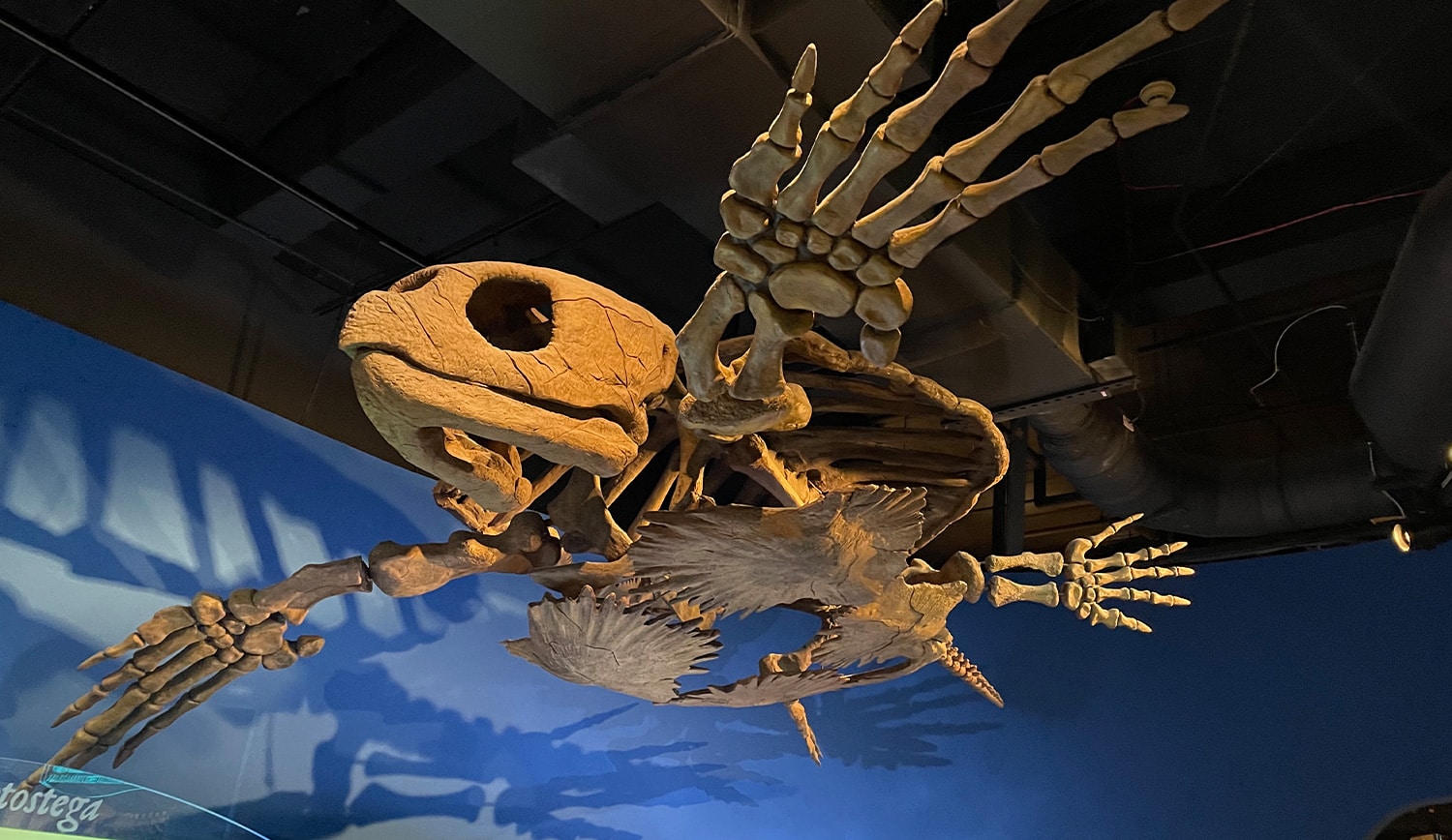
Come fly with us !